
Overview
of facilities
Crude Oil Storage Tanks
The Crude oil storage and blending facility consists of 9 completed concrete in-ground fixed roof tanks, each with a capacity to store 1.1 million barrels. The construction of the tanks included three layers of barriers, i.e.
- The primary liquid container constructed of concrete including the acrylonitrile coated internal surface;
- A leakage monitoring layer between the primary and secondary containment layers;
- A HDPE secondary containment layer which encapsulates the entire tank containing both the tank liquid and vapour storage volumes.
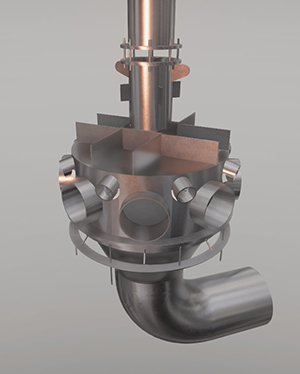
The tanks are used for both storage and blending of different grades of crude oil. The blending will be either in-line blending or using the jet nozzles situated at the bottom of the tanks. The performance of the jet nozzles was evaluated using CFD modelling for both mixing / blending, the jet range and re-suspension of solids.


Click image above to enlarge:
Structural Analyses
Full finite element models were completed for the concrete tank design. In addition, a separate finite element model was developed for the seismic analysis of the tanks to ensure the structural stability of the system in all operating conditions.

Tank with Half Roof

Tank with Full Roof

Jet Nozzles
Each tank is equipped with two inlet/outlet pipes, each with a diameter of 32’and a center water drain with a diameter of 20’. The inlet & outlet pipes are each fitted with a low velocity nozzle which is used to circulate the crude oil in the tanks and re-suspend sediments.


Blending
Aquarius MOGS Saldanha is the first dedicated crude oil storage & blending terminal. A Jiskoot Jetmix in-line crude oil blending system is installed and used for 2 main purposes:
To blend the maximum amount of a lower percentage volume heavy, viscous oil into premium lighter, less viscous crude in order to realize the largest volume of saleable blended product possible. This is to be achieved whilst maintaining the blend within the desired physical properties & utilizing the highest amount of heavy crude possible.
To blend other medium crude oils of various densities & viscosities in more equal ratios, to make them suitable for a broader range of refinery type end-users where these will be processed. Here also ensuring that the desired range of physical properties (density) are maintained throughout the batch.
Options that exist in the automatic blending process:
- Ratio blending – fixed volume
- Quality Trim Blending – Density @ specific temperature
- Quality Trim Blending – Viscosity @ reference temperature

